
Garage Floor Coatings
Garage floor coatings done right.
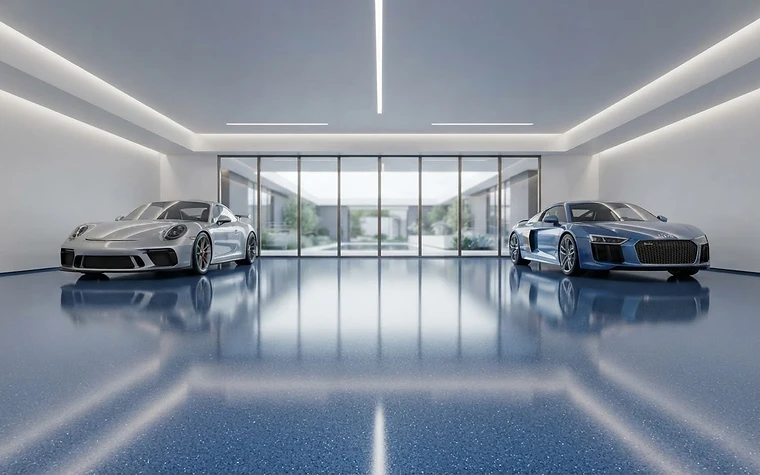
Decorative flake epoxy with a UV-stable polyaspartic topcoat. Stained, cracked concrete becomes a seamless, high-gloss surface that shrugs off everything Northwest Houston life throws at it.
Why Epoxy + Polyaspartic
Built for Texas garages.
Big-box epoxy yellows in the sun and peels off unprepped concrete. Our system pairs a moisture-tolerant epoxy base with a UV-stable polyaspartic topcoat, over concrete we've actually ground and repaired.
Stain & Chemical Proof
Oil, grease, brake fluid, and battery acid wipe right off — no etching, no shadowing.
UV-Stable, Never Yellows
Polyaspartic resin holds its color and gloss under the Texas sun for years.
Slip-Resistant Texture
Flake broadcast adds grip, even when wet — safer for kids, pets, and wet boots.
Built to Last
An epoxy base for the bond, a polyaspartic topcoat for the wear. Done right the first time.
Before & After
Drag the slider. See the difference.


Sample image — Kyle's real garage photos go here
Our Process
Five steps. No shortcuts.
Every floor gets the same careful prep, quality materials, and attention to the details that make it last.
Prep
We diamond-grind the concrete to open the pores and remove every stain, coating, and imperfection — with dust suppression.
Repair
Cracks, spalls, and pitting are filled and leveled so the finished floor is seamless and structurally sound.
Base Coat
A moisture-tolerant colored epoxy base coat bonds directly to the concrete for a quality foundation.
Flake
Your chosen decorative flakes are broadcast to full refusal for a textured, slip-resistant, custom finish.
Topcoat
A UV-stable clear polyaspartic topcoat locks the flakes in and delivers a high-gloss sheen.
The Complete Guide
Garage floor coatings in Northwest Houston, explained.
Everything a homeowner in Magnolia, Tomball, Cypress, Waller, or Hockley should know before choosing a garage floor coating: what the system is, why the prep matters more than the product, what it costs, and how to tell a floor that will last from one that will peel.
What a garage floor coating actually is
A garage floor coating is a bonded, multi-layer resin system applied directly to your concrete slab. Done right, it becomes part of the floor rather than a layer sitting on top of it. The version we install at Bluebonnet Epoxy Co. is a decorative flake system: a colored epoxy base coat, a full broadcast of vinyl flakes in the blend you choose, and a clear polyaspartic topcoat that locks everything in and gives the floor its gloss and its toughness.
People search for "epoxy garage floor" and "polyaspartic garage floor" as if they were competing products. In practice the best garage floor coating uses both, each where it performs best. Epoxy is the right material against the concrete. It wets into the surface, tolerates the moisture that comes up through Houston-area slabs, and bonds harder than anything else you can put on bare concrete. Polyaspartic is the right material on top. It is UV-stable, so it will not yellow in the sun coming through an open garage door, and it cures to a harder, more abrasion-resistant finish that handles hot tires, dropped tools, and dragged toolboxes.
The flake layer between them is not just decoration. A full flake broadcast gives the floor texture for traction, hides minor imperfections in the slab, and adds thickness that a plain solid-color coating does not have. It also hides dust, tire marks, and the odd drip in a way a solid floor never will.
Why the prep is the whole job
Almost every failed garage floor we are asked to look at failed for the same reason: the concrete was not properly prepared before the coating went down. Big-box epoxy kits tell you to clean the floor and acid-etch it. That opens the surface a little, but it leaves a weak, powdery layer behind and does nothing about old sealers, oil contamination, or the smooth, burnished finish most builders trowel onto a garage slab. A coating applied over that will look fine for a few months and then lift in sheets.
We mechanically diamond-grind every floor with a walk-behind grinder and vacuum dust extraction. Grinding removes the weak top layer, opens the pores of the concrete, and creates a profile the base coat can physically anchor into. On Northwest Houston slabs, which are often relatively young and still curing, we also check moisture before we coat. A moisture-tolerant epoxy base coat is part of how we handle that, but knowing what the slab is doing before we start is the other part.
After grinding, cracks get chased and filled with a rigid repair compound, pitted areas get skim-coated, and control joints are addressed so they do not telegraph through the finish. Only then does the first coat go down. If a contractor quotes you a garage floor without mentioning grinding, ask what they plan to do instead. The answer tells you how long the floor will last.
How long a garage floor coating lasts, and what shortens it
A properly prepped flake-and-polyaspartic garage floor is measured in decades, not years. The topcoat takes the wear, and the bond between epoxy and ground concrete is not something normal use disturbs. The things that shorten the life of a coated floor are almost all prep-related: coating over a sealer, coating over a slab with moisture problems and no moisture-tolerant base, or skipping the grind. Beyond that, the biggest enemy of any garage floor is a single-coat, thin-build system that simply does not have enough material on the slab to absorb wear.
Is an epoxy garage floor worth it? For most homeowners the honest answer is yes, with one condition: it has to be the full system. A cheap kit is a cheap kit. A professionally installed flake floor is the last thing you will do to that slab, it adds real value to the house, and it turns the garage into a space you actually use.
What you can do to keep it looking new
- Sweep or dust-mop regularly. Grit is the only thing that will dull a polyaspartic topcoat over time.
- Rinse with a hose and a squirt of mild soap. No harsh degreasers needed.
- Wipe up chemical spills when convenient. Brake fluid and battery acid will not damage the floor, but nothing benefits from sitting in them.
- Use a mat under motorcycle kickstands and jack stands. Point loads on a small footprint can mark any floor.
What a garage floor coating costs in the Houston area
We publish our pricing because we think you should be able to plan before you call. A typical two-car garage in Northwest Houston runs about $2,400 with our full flake-and-polyaspartic system. Our project minimum is $1,400, which covers small single-car garages and similar spaces. The Pricing page has the details on what moves the number.
The three things that change the price are square footage, the condition of the concrete, and how much edge work is involved. A heavily pitted slab or one with an old failing coating that has to come off takes more prep time. Coating up the stem wall or onto a step adds surface area. Standard flake blends are included; custom blends built to your request are available at additional cost. What does not change the price is the quality of the system. Every floor gets the same grind, the same base coat, the same full flake broadcast, and the same polyaspartic topcoat.
If you are comparing quotes, compare what is actually in them. A lower number that turns out to be a single coat of water-based epoxy with a light flake sprinkle is not the same product, and it will not last the same amount of time.
Choosing a flake color for your garage
We carry twelve standard blends, from dark charcoals like Carbon and Orbit to warm tans like Coyote and Shoreline. Mid-tone greys such as Gravel and Nightfall are the most popular choice for garages because they hide dust and tire marks while still reading as bright and clean. Darker blends look sharp and hide everything, but show dust more readily. Lighter blends brighten a garage dramatically and pair well with white or light-colored walls.
Browse the full set on our Flake Colors page. We bring physical sample chips to every estimate so you can see the blend in your own garage under your own lighting, which matters more than any photo.
Garage floor coatings across Northwest Houston
Bluebonnet Epoxy Co. is based in Magnolia and coats garage floors throughout the northwest side of the Houston metro. That includes Magnolia, Tomball, Cypress, and Waller and Hockley, along with Pinehurst, Spring, and the western edge of The Woodlands. If you are searching for a garage floor coating company near you in northwest Harris, southern Montgomery, or Waller County, we are close.
Being local matters for a reason beyond convenience. We know how slabs in this area behave: the clay soils, the moisture that moves through relatively young concrete, and the sun that comes through a west-facing garage door in August. The system we install and the way we prep for it are built around those conditions.
How to get started
Request a free quote and we will come out, measure the space, check the condition and moisture of the slab, and give you a written price. There is no obligation, and the price we write down is the price you pay unless the scope changes. We will also bring sample chips so you can pick your flake blend on the spot.
You can reach us at 346-332-9612 by call or text, or use the Free Quote form. We show up when we say we will, we do the prep nobody else wants to do, and we stand behind every floor we finish.
FAQ
Garage floor coating questions, answered.
What is the difference between epoxy and polyaspartic garage floor coatings?
How much does a garage floor coating cost in Northwest Houston?
How long does an epoxy garage floor last?
Do you grind the concrete or acid-etch it?
Can you coat a garage floor that already has an old coating on it?
Will hot tires peel the coating?
Is a garage floor coating slippery when wet?
What areas do you serve for garage floor coatings?
Ready to transform your floor?
Free on-site estimates. Written quotes. We show up when we say we will.