
Patio Coatings
Outdoor living, elevated.
The same decorative flake system we use on garage floors, built for your covered patio or back porch. Cracked, stained concrete becomes a seamless, slip-resistant surface that holds up to the Texas sun.

Outdoor Performance
Made for the Texas sun.
Patios take a beating from sun, rain, grills, and foot traffic. Our flake-and-polyaspartic system handles all of it without fading, peeling, or getting hot.
Seamless & Easy to Clean
No grout lines, no seams. Rain, dirt, and spilled drinks rinse right off.
Cooler Underfoot
Light flake blends reflect heat, so bare feet stay comfortable through a Texas summer.
Won't Fade in the Sun
UV-stable polyaspartic topcoat keeps your color true season after season.
Slip-Resistant Finish
Textured flake surface adds grip when the patio is wet.
Real Project
From stained concrete to a patio you want to sit on.
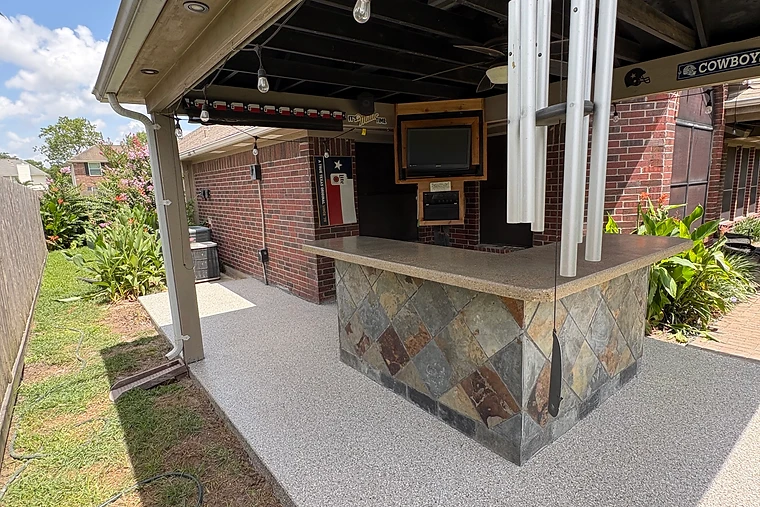
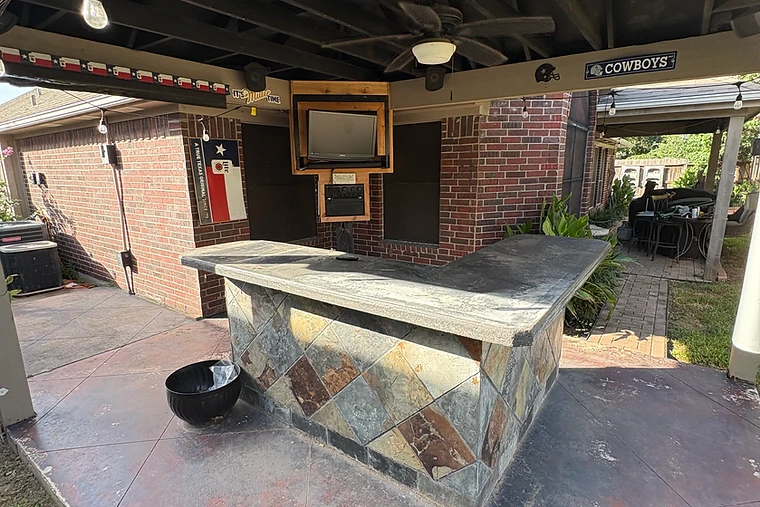
Covered Patio & Outdoor Kitchen — Northwest Houston, TX
Our Process
Five steps. No shortcuts.
Every floor gets the same careful prep, quality materials, and attention to the details that make it last.
Prep
We diamond-grind the concrete to open the pores and remove every stain, coating, and imperfection — with dust suppression.
Repair
Cracks, spalls, and pitting are filled and leveled so the finished floor is seamless and structurally sound.
Base Coat
A moisture-tolerant colored epoxy base coat bonds directly to the concrete for a quality foundation.
Flake
Your chosen decorative flakes are broadcast to full refusal for a textured, slip-resistant, custom finish.
Topcoat
A UV-stable clear polyaspartic topcoat locks the flakes in and delivers a high-gloss sheen.
The Complete Guide
Patio floor coatings for Texas backyards.
A stained, cracked concrete patio is one of the most common eyesores in a Northwest Houston backyard, and one of the easiest to fix for good. Here is how a flake-and-polyaspartic patio coating works outdoors, where it makes sense, and what to expect.
Can you put epoxy on an outdoor patio?
Yes, with one important caveat: not plain epoxy. Epoxy on its own is not UV-stable. Left exposed to the sun it ambers, chalks, and eventually breaks down at the surface. That is why so many DIY patio coatings look tired within a year. The system that works outdoors is the same one we use in garages: an epoxy base coat for the bond to the concrete, a full flake broadcast for texture and color, and a clear polyaspartic topcoat on top. Polyaspartic is what makes the floor sun-proof. It does not yellow, it does not chalk, and it holds its gloss through a Texas summer.
So when you search for an epoxy patio floor or a concrete patio coating, what you actually want is a flake system finished in polyaspartic. That is what we install on every patio, porch, and outdoor kitchen floor.
Why a coated patio beats stained or bare concrete
Most patios in our area are either bare broom-finished concrete or an acid stain that has faded unevenly. Both have the same problems: they absorb everything, they are hard to clean, and they crack and spall as the slab moves. A flake coating solves all three at once.
- Seamless and non-porous. Rain, mud, grill grease, and spilled drinks sit on the surface and rinse off with a hose instead of soaking in.
- Slip-resistant. The flake texture adds grip when the patio is wet, which matters around outdoor kitchens and covered porches where people walk barefoot.
- Cooler underfoot. Lighter flake blends reflect heat rather than absorbing it the way dark stained concrete does.
- Hides the slab. Discoloration, old stain, patched areas, and minor pitting disappear under a full flake broadcast.
- Matches the house. Twelve standard blends, from stone greys to warm tans, so the patio floor ties into brick, siding, and pavers instead of fighting them.
How we prep an outdoor slab
Outdoor concrete is harder to coat than a garage floor because it has been exposed to weather, and often to years of sealers, stains, and pressure-washing. We mechanically diamond-grind every patio to remove whatever is on the surface and open the pores of the concrete. Old acid stain, clear sealers, and the weak top layer of the slab all come off in that step.
Cracks are chased and filled. Spalled or pitted spots are skim-coated flat. Expansion joints are cleaned out and either honored in the finish or filled with a flexible joint compound, depending on the slab. Then the moisture-tolerant epoxy base goes down, which matters even more outside because ground moisture moves through an exterior slab constantly. The flake broadcast and polyaspartic topcoat follow.
Weather affects outdoor scheduling more than it affects garage work. We will not coat a patio in the rain or when temperatures and humidity are outside the working range of the materials. We will tell you what to expect and we will show up when we say we will.
Where a patio coating makes sense, and where it does not
Covered patios and back porches are the ideal application. The roof protects the floor from the worst of the sun and standing water, and the coating turns the space into a true outdoor room. Outdoor kitchens are a close second, because the seamless surface is so much easier to keep clean around a grill. Uncovered patios work well too as long as the concrete is sound and drains properly.
Where we say no: slabs with active structural cracks that are still moving, slabs that hold standing water, and slabs so badly deteriorated that grinding would not leave a solid surface behind. If your patio is in that condition, we will tell you at the estimate rather than coat it and have it fail.
A real Bluebonnet patio in Northwest Houston
The before-and-after above is one of our own projects: a covered patio and outdoor kitchen with a stained, patchy red concrete floor. After grinding, crack repair, and a full grey flake broadcast under a polyaspartic topcoat, the floor is seamless, uniform, and slip-resistant, and it finally matches the slate bar and brick behind it. That is the difference between a patio you tolerate and one you want to sit on.
See it larger in the Gallery, or look at the Flake Colors to see how different blends would read against your house.
Patio coating pricing
Patios are priced the same way as garages: by square footage and by the condition of the concrete. Our project minimum is $1,400, and a typical covered patio lands in the same range as a two-car garage. The Pricing page explains what moves the number. If you are doing a garage and a patio together, tell us. Same-visit projects are simpler for us to schedule and we can price them accordingly.
Patio coating vs. pavers, stamped concrete, and tile
Homeowners weighing a patio coating usually compare it against three alternatives. Pavers look great but sit on a sand bed that shifts, grows weeds in the joints, and needs periodic re-leveling. Stamped concrete is a new pour, which means demolition of the existing slab and a much larger budget, and the color release on stamped concrete fades and needs resealing. Outdoor tile is expensive, the grout stains, and tile over an existing slab that moves will crack along with it.
A flake coating works with the slab you already have. There is no demolition, no new concrete, no grout, and no joints for weeds. The cost is a fraction of a new pour, and because the finish is seamless there is nothing to re-sand, re-seal, or re-level later. For a patio that is structurally sound but ugly, it is almost always the highest-value option.
Design ideas: matching the patio to the house
The most common mistake we see in outdoor flooring is picking a color in isolation. A patio floor sits next to brick, siding, stone, and whatever the pool deck or walkway is made of, and the blend should tie those together rather than add another competing color.
Red or brown brick homes
Warm neutral blends like Coyote, Shoreline, and Cabin Fever pick up the tones in the brick without matching it exactly. Cool greys like Gravel can also work as a deliberate contrast against red brick, which is what the patio in our gallery uses.
Grey, white, or painted brick and modern siding
Gravel, Orbit, and Nightfall read clean and current against grey and white exteriors. Domino, the black-and-white blend, is a bold choice for a modern covered patio with black trim.
Stone, slate, and natural materials
Creekbed and Wombat sit comfortably next to natural stone and slate. If your outdoor kitchen has a stone veneer, bring a piece of it to the estimate and we will hold sample chips up against it.
Caring for a coated patio
A polyaspartic patio floor is about as low-maintenance as an outdoor surface gets. Hose it off when it gets dirty. Use a broom or a leaf blower for leaves and grit, since grit is the one thing that will dull any finish over time if it is ground underfoot for years. A mild soap and a soft brush handle grill grease and mildew in shaded corners. No sealing, no resealing, no re-sanding of joints, and no pressure-washing required, although pressure-washing will not hurt it.
Furniture with hard plastic or metal feet can be dragged across the floor without scratching the topcoat, but felt or rubber pads under heavy pieces are still a good idea for the same reason they are on any floor.
Serving patios across Northwest Houston
We coat patios, porches, and outdoor kitchen floors throughout Magnolia, Tomball, Cypress, Waller and Hockley, Pinehurst, and Spring. Call or text 346-332-9612 or use the Free Quote form and we will come look at your slab.
FAQ
Patio coating questions, answered.
Can epoxy be used on an outdoor patio?
Will a coated patio be slippery when wet?
Does the coating get hot in the sun?
Can you coat a patio that has already been acid-stained or sealed?
What about cracks in the patio?
How much does a patio coating cost?
Ready to upgrade your patio?
Free on-site estimates. Written quotes. We show up when we say we will.